
Turkish, caucasian and moldavan kilims
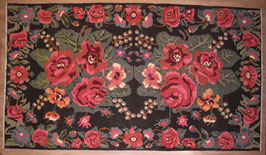
Modova : 3,37 x 1,88 m
Moldavian kilim, wool, circa 1960. Very good condition.
Lots of freshness on this elegant kilim featuring a flower motif on a lightly shaded black background. Two bouquets of flowers, including roses and foliage, are surrounded by a flowery garland acting as a border.
Roses motif (Göl Farangi):
The influence comes from the Damascus rose, whose rose motif inspired Sefevid carpets, which in turn probably influenced European tapestries. At the end of the 19th century and beginning of the
20th, the göl farangi motif, which means rose or flower of France, is found in the East on carpets and kilims from Karabagh (Caucasus), on certain Iranian carpets such as those from Bidjar,
Senneh and the Bakthiar from the village of Faradoumbeh, as well as on Moldavian (Moldavia) and Göçnems (Bulgaria) kilims from the Balkans.


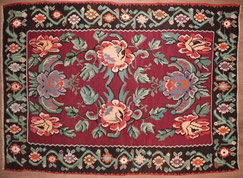
Goçmen : 3,10 x 2,30 m
Bulgarian wool kilim, circa 1950. Very good condition.
Beautiful Göçmen kilim featuring floral motifs across its entire surface. Against a burgundy red background, large rose and foliage motifs are surrounded by a border depicting a garland of flowers on a black background. Openwork weaving technique.
The art of weaving carpets and kilims has a long history in Slavic countries and the Balkans, particularly due to the conquests of the Ottoman Empire beginning in the mid-14th century.
Under Suleiman the Magnificent (1520–1566), the Ottoman Empire included Serbia, Bosnia, and Albania.
Rose motif:
The influence comes from the Damask rose, whose rose motif inspired Safavid carpets, which in turn likely influenced European tapestries. In the late 19th and early 20th centuries, the göl
farangi motif—meaning “rose” or “flower of France”—appeared in the East on the carpets and kilims of Karabakh (Caucasus), on certain Iranian carpets such as those from Bidjar, Senneh, and the
Bakthiar from the village of Faradoumbeh, as well as on Moldavian kilims (Moldova) and göçnems (Bulgaria) from the Balkans.
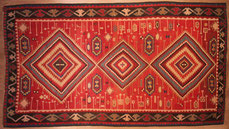
Karabagh Caucasus : 3,45 x 1,85 m
Caucasian wool kilim, cotton warp, circa 1940. Good condition. Some restorations have been carried out over time. Fine work. Rare.
Note: a few stains on the back of the kilim.
Beautiful and timeless karabagh in kellé format (head rug) with geometric patterns. Three medallions worked on an abrached red background* are surrounded by a multitude of motifs: flowers,
zoomorphs, hourglasses which 'translate' the passing of time. A beautiful border with a (geometric) floral pattern is framed by two zigzag 'running water' borders representing a stream of water
and life. Two letters in ancient Armenian 'T' and 'A' can be translated as 'Armenian Carpet'. This authentic kilim is the perfect example of an Armenian village tradition.
*Abrache: term designating a variation of tones in the same color.

Aydin Türkiye : 3,00 x 1,70 m
Kilim from southwestern Anatolia (Turkey), Aegean side, wool, around 1952.
Beautiful graphics for this kilim bright, colorful and traditional. Between each hexagon, the hand of Fatima is represented symbolically as a talisman to protect oneself from the 'evil eye'. The
five fingers of the hand refer to the term 'khamsa' meaning five in Arabic and Hebrew. Zoomorphic spiders surround each hexagon.
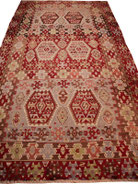
Eçme Türkiye : 3,30 x 1,80 m
Eçmé or Cesmé kilim from western Anatolia (Türkiye), Aegean coast, wool, cotton warp and weft, circa 1950. Very good condition. The breaks have been restored in our workshop.
Great care went into the making of this kilim, revealing great mastery in the design, the choice of colors, and the finesse of the work. Zoomorphic, 'S' motif. The 'S' motif originally
represented a two-headed dragon, which could be seen on ancient Persian, Chinese, and Celtic bronzes. Abrache: a term describing a variation of tones within the same color. An interesting size, a
piece that is becoming increasingly rare. A solid and durable kilim.

Eçme Türkiye : 2,96 x 1,86 m
Kilim from western Anatolia (Turkey), Aegean side, wool, 1950. Very good condition. Solid.
Beautiful timeless kilim from the 50s, in bold colors, taking up the hourglass motif evoking "passing time". Beautiful abraché colors. Polychrome fringes on one side (see photos).
Abrache: term designating a variation of tones in the same color.

Türkiye : 3,23 x 1,72 m
Anatolian Kilim (Turkey), wool, circa 1950. Very good condition. The tacks have been restored in our workshop. Note: some color bleeding (black) in the border (see photos).
Kilim with a clean design and patinated, abrached colors. At each end, there is the 'S' motif, originally representing a two-headed dragon, which could be seen on ancient Persian, Chinese, and
Celtic bronzes. Abrached: a term describing a variation of tones within the same color.
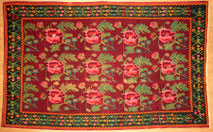
Karabagh Caucasus : 2,28 x 1,46 m Sold
Caucasian wool kilim, cotton weft, 1950-60. Very good state.
Karabakh is a region located in the southwest of Caucasian Azerbaijan. Karabakh designs are varied. One can find patterns of roses (göl farangi, like this one, or geometric patterns. Karabagh can
be translated as "black garden". Karabaghs are also made with knotted stitches. The best Karabagh achievements were most often Kurdish and Armenian stock. Which is probably the case with this
(Armenian) kilim.
A lot of freshness in this Karabakh kilim, both in its patterns (pinks) and its colors. We find the "göl farang" pattern * on the entire surface , surrounded by a border with a pattern of
stylized bouquets. Fine workmanship.
*Göl farang: The influence comes from the Damascus rose whose rose pattern inspired Safavid carpets, which in turn influenced European tapestries. At the end of the 19th century and at the
beginning of the 20th century, the göl farangi motif which means rose or flower of France is found in the East on carpets and kilims from Karabakh (Caucasus), on certain Iranian carpets such as
bidjars and bakthiars from the village of Faradoumbeh , as well as on the s Moldavian Balkan kilims.