
Persian Kilims
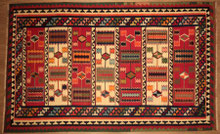
Gashghaï Kashkuli Iran : 2,76 x 1,71 m
Iranian wool kilim, 1970-80. Very good state.
Fine work for this kilim in bold colors. Its 'contemporary' geometry combined with traditional motifs ('wine glass' border, 'hooks', 'running water', 'comb' motif) make this kilim a timeless
piece.
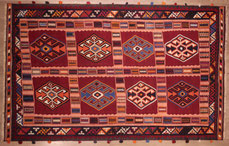
Gashghaï Kashkuli Iran : 2,70 x 1,66 m Sold
Iranian wool kilim, circa 1960. Very good condition. Some restorations over time.
Amazing graphics for this Gashghai Kashkuli kilim with box patterns inserting zoomorphic spiders on a burgundy red background. The 'comb' pattern draws each box. The comb, the hand and the
fingers represent fertility, the desire for marriage and the protection of offspring against the 'evil eye'. Different geometric and colored borders frame this authentic kilim. Openwork weaving
technique. Reversible kilim.
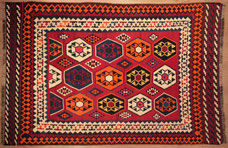
Gashghaï Kashkuli Iran : 2,40 x 1,60 m
Iranian wool kilim, 1970. Very good condition.
Fine work for this beautiful luminous kilim. Hexagons framed by different borders stand out against a red background, including an orange 'aleh abassi' border (tulip border), and a border with a
cross pattern, a symbol of protection, on an ecru background.
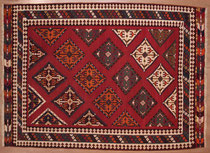
Gashghaï Kashkuli Iran : 2,16 x 1,57 m
Iranian wool kilim, circa 1950-60. Very good condition.
On a red background stand out diamonds framed by two ecru 'aleh abassi' borders (tulip borders) and a polychrome border with a brickwork pattern. Beautifully made.
The kashkulis correspond to an ethnic group that is part of the Gashghai confederation (Fars, southwest Iran). The Gashghai confederation includes different tribes: (some examples: the Kashkulis Bozorgs (the big ones), the Kashkulis Kucheks (the small ones), the Shishbolukis (six districts), the Amalehs or Yamalehs (workers, servants of the Khan).
In nomadic tribes, carpets and kilims were of vital importance. Indispensable to the life of nomads, they served as insulation in the yurt, as bags or satchels for everyday life (gorjin, mafresh, namakdan ...). They were used to store goods and food. The ethnic and rustic side of these creations shows an authentic and artistic know-how.
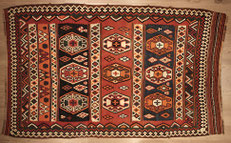
Gashghaï Kashkuli Iran : 2,70 x 1,65 m
Iranian wool kilim, circa 1920. Good condition.
Beautiful balance of patterns and colors for this old kilim who despite his age has kept his bright colors. Beige border 'ale abassi' (tulips). Zoomorphs of spiders on the field of the kilim.

Gashghaï Kashkuli Iran : 2,40 x 1,44 m Sold
Iranian kilim from the Fars region (southwest Iran), wool, circa 1960. Very good condition.
Beautiful color harmony for this original kilim. On a raspberry 'abraché' background (changes in tone within the same color) are depicted black and orange medallions containing zoomorphic
figures. Prominent borders frame the kilim's field: the 'Aleh Abassi' border*, the 'Running Water' border**, and the 'Göl' motif***. Bands on either side complete this beautiful, authentic
kilim.
* Aleh Abassi: tulip border.
**Running Water: flowing water representing life.
*** Göl or Gul: a small geometric medallion in the shape of a polygon, meaning 'flower' in Persian.
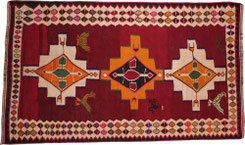
Gashghaï Kashkuli Iran : 2,50 x 1,48 m
Iranian kilim from the Fars region (southwest Iran), wool, circa 1960. Very good condition.
Three medallions stand out against a deep red 'kafzade' (solid) and abraché (a term describing variations in tone within the same color) background. Four hens and roosters, along with a black
horseman holding a banner, adorn the field of this authentic kilim in an unusual way. A beautiful beige border with polychrome motifs frames the field.

Gashghaï Kashkuli Iran : 2,40 x 1,58 m
Iranian kilim from the Fars region (southwest Iran), wool, circa 1960. Good condition. Some signs of wear.
On a plain red 'kafzade' and abraché (a term describing variations in tone within the same color) background, eight medallions frame five butterflies. Various colored and stylized borders enhance
this authentic kilim.
The Gashghai confederation comprises different tribes. Some examples: the Bozorg Kashkuli (the tall ones), the Kuchek Kashkuli (the short ones), the Shishboluki (six districts), and the Amaleh or
Yalameh (workers, servants of the Khan).
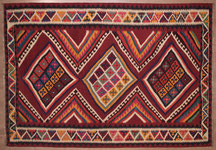
Gashghaï Kashkuli Iran : 2,49 x 1,70 m
Iranian wool kilim, circa 1960. Good condition.
This brightly colored kilim features three diamonds surrounded by stylized motifs. Various colored borders enhance the overall look of this Kashkuli kilim. Sturdy and durable.
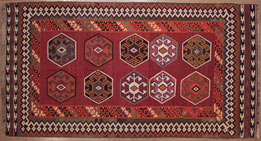
Gashghaï Kashkuli Iran : 2,50 x 1,33 m
Iranian wool kilim, circa 1960. Very good condition.
Great care was taken in the making of this kashkuli. On a patinated red background, ten hexagons in different colors are depicted, incorporating zoomorphic spiders. Colorful and varied borders,
including a beige 'aleh abassi' (tulip border), frame this beautiful and authentic kilim. Fine workmanship.
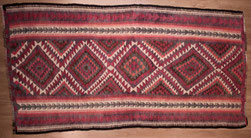
Khamseh Iran : 2,96 x 1,52 m Sold
Kilim from the Fars region, southwest Iran, wool, circa 1950. Restoration of the bartacks on one side in our workshop. Very good condition. Thick, strong and durable kilim.
Dimensions: 296/284 x 152 cm.
The name Khamseh corresponds to a confederation of five nomadic tribes who lived in southwest Iran. This confederation was formed from the mid-19th century to oppose the Gashghais. Khamseh means
"confederation of five". Khamsa or khomsa means "five" in Arabic. In North Africa, khamsa is a talisman symbolizing a protective hand. Due to the diversity of ethnic groups constituting the
Khamseh confederation, we find varied patterns: medallions, hexagons, botehs, ...
Authentic Khamseh kilim in 'kellé' format in shades of pink, beige and gray with geometric patterns in its center surrounded by different stylized borders. This kilim was made on a horizontal
loom, traditionally used by nomads when traveling, which explains its narrow format (kellé carpet) and its asymmetry.
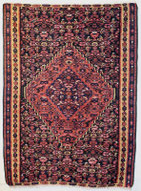
Senneh Iran : 1,44 x 1,05 m
Kilim senneh from Iranian Kurdistan, wool, circa 1950. Very good condition. The breakpoints have been restored in our workshop.
The city of Sanandaj, formerly called Senneh, is located in Iranian Kurdistan. The 'senneh' knotted-stitch rugs are famous but the 'senneh' kilims are also very popular with lovers of authentic
rugs. The work is, in fact, very refined both in the production technique and in the designs which have been perpetuated over the centuries. The work is, in fact, very refined both in the
production technique and in the designs which have been perpetuated over the centuries.
Senneh kilims or knotted sennehs are most often made with the mahi pattern (diamond-shaped fish pattern), like this one. This is a zaronim format kilim, with warm and strong colors, giving a lot of authenticity. Openwork weaving technique. Tendency to become rarer.
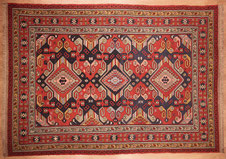
Azerbaïdjan Iran : 2,42 x 1,70 m
Soumak from Iranian Azerbaijan wool, 1970-80. Good condition with some usual wear. Strong and durable.
Soumak is a wrapped weft weaving technique (embroidery). On the reverse side, the woolen threads are intentionally left. On the old soumaks, these woolen threads made a thickness and had the
function of insulation.
Beautiful balance of colors for this authentic soumak with geometric patterns.
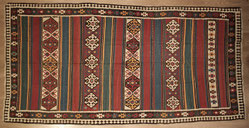
Shahsavan Azerbaïdjan Iran : 3,18 x 1,55 m
Kilim of Azerbaijan Iranian wool, around 1950.
Kilim format kellé having kept its beautiful colors 'abrachées' of origin. A border 'ale abassi' (border tulip) beige surrounds the kilim.
There are similarities with some Gashghais kilims, Fars region (southwestern Iran).

Shahsavan Iran silk : 2,80 x 0,65 m
Shahsavan (soumak) Iranian silk, cotton warp, 1990-2000. Very good state.
Soumak shahsavan in kenareh format requiring great mastery in its creation both in the patterns and in the harmony of the colors. On an ivory background, eight medallions surrounded by a
multitude of zoomorphs of birds stand out. A refined border, on a pearl gray background, features the eight-pointed 'star of Medes' motif.
The territory of the Shahsavans is located south and west of the Caspian Sea, in Iranian Azerbaijan. Made up of Kurdish, Persian, Turkish, Tajik and Caucasian ethnic groups, the Shahsavan
confederation was formed under the reign of the Safavid ruler Shah Abbas (reigned 1587-1629).
Soumak is a wrapped weft weaving technique (embroidery). On the reverse side, the wool threads are deliberately left. On ancient soumaks, these woolen threads were thick and had the function of
insulation.
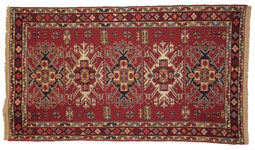
Shahsavan Iran : 1,96 x 1,13 m
Kilim soumak shahsavan iranian wool, woolen chain, late twentieth.
Soumak consisting in his field of five medallions on a deep red background. Two beige borders with zoomorphs of two-headed dragons frame a border composed of mosaic-like patterns. Beautiful patina.
Soumak is a wrapped weft weaving technique (embroidery). On the reverse side, the wool threads are deliberately left. On ancient soumaks, these woolen threads were thick and had the function of insulation.