
Ancient Persian, Caucasian, Anatolian carpets
Fruit of tribal, village and academic achievements, antique rugs are increasingly interesting for many amateurs. They are the expression of an ancestral art that still influences and inspires major or more modest works today. The folkloric, rustic and primitive side of the carpets of tribes and villagers shows a great humanity while the academic and workshop carpets impress with their finesse and complexity of realization. Increasingly rare, these 'works' reflect the end of an era.
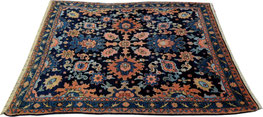
Bidjar Iran : 1,77 x 1,35 m Sold
Carpet from Iranian Kurdistan (western Iran), Kurk wool (fine lamb's wool), cotton warp and weft, circa 1890. Despite its age, the carpet is in very good condition and the colors have not faded.
The carpet has been expertly restored by a master weaver who has rewoven the fringes on one side. Rare.
Bidjar carpets are highly valued for their great durability and resistance to wear. These rugs are prized by enthusiasts for their authenticity and typically Persian charm.
Rugs from Bidjar and the surrounding villages are made using the Turkbaff knot (double
knot). A traditional Bidjar has 3 to 5 rows of warp threads. Furthermore, the quality of the wool and the weaving technique make these rugs virtually indestructible. They are sometimes called
'iron rugs'.
This splendid Bidjar features a floral motif that is both classic and timeless. Against a navy blue background, the motifs are harmoniously blended in a palette of matching colors. Traditional
borders frame this design. A strong and durable rug, thick yet supple.


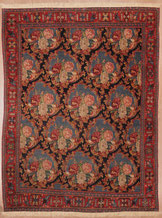
Senneh Iran : 2,00 x 1,51 m
Iranian Kurk wool rug, wool warp and weft, circa 1880. This rug has been restored according to traditional methods by a master weaver who added silk fringes due to the rug's fineness. It is in
very good condition considering its age and has a beautiful patina. Exceptional and rare.
The former name of the city of Sanandaj, Senneh, is located in Iranian Kurdistan and is renowned for its knotted pile rugs. Senneh kilims are also highly prized by lovers of authentic rugs. The
craftsmanship is exquisite, both in the techniques used and in the designs, which have been passed down through generations.
This magnificent Senneh rug, in dozar format, features the 'Göl farang' (Rose of
France) motif across its field. Bouquets of three flowers are set within richly detailed medallions. Traditional borders frame this composition. This rug is exceptional in its quality and color
harmony.
The 'Göl Farangi' motif: Its influence comes from the Damask rose, whose rose motif inspired Safavid rugs, which in turn influenced European tapestries. At the end of the 19th and beginning of
the 20th centuries, the göl farnagi motif, meaning rose or flower of France, reappeared in the East on rugs and kilims from Karabakh (Caucasus), on certain Iranian rugs such as those from Bidjar,
Senneh, and the Bakhtiar of the village of Faradoumbeh, as well as on Moldavian kilims from the Balkans.


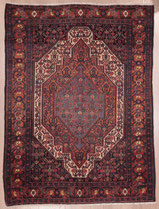
Senneh Iran : 1,44 x 1,07 m
Iranian wool rug, cotton warp and weft, circa 1940. Very good condition considering its age. Even wear throughout. The knots have been repaired in our workshop. A solid and durable rug.
Authentic Senneh, zaronim format, featuring a traditional motif, probably of Kurdish origin. In the center, a blue medallion is set within a patinated red medallion, which is itself set within a
medallion on a beige background. Four spandrels frame the center. The main border is decorated with the 'boteh' motif* and flowers.

*Boteh: An ancient motif with various meanings. It can represent the transformation of Zoroaster into a cypress tree, a symbol of eternity, but also into a drop of water, a palm tree, or a tree. The term boteh means "flowering bush" in Persian. There is a similarity to yin and yang.
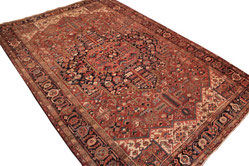
Iran Heriz : 3,30 x 2,25 m
Iranian wool rug, cotton warp and weft, circa 1920. Normal wear and tear for its age, but the rug remains sturdy. The borders and end stitches have been restored.
Located in Iranian Azerbaijan, east of Tabriz, Heriz is a town that brings together the production of neighboring villages such as Ahar, Goravan, Serapi, and Bakhshayesh. Heriz rugs are renowned
for their strength and durability, thanks to the excellent quality of the wool and the Turkbaff knot. Heriz rugs with geometric designs and central medallions are inspired by a family tradition.
At the end of the 19th century, merchants from Tabriz commissioned large-scale rugs to be woven in Heriz, giving them a more refined look. Despite this shift, many weavers refused to use cartoons
and instead relied on traditional designs or "vaghirehs" (designs). During this period and until the beginning of the First World War, silk carpets were also produced. They are now very rare and
highly sought after.
This authentic traditional heriz features a central medallion whose octagonal 'heart' represents the Universe. Various motifs are found within, such as boteh*, eight-pointed Median stars, and göl
(flowers). The main border repeats a göl and boteh motif, framed by two smaller borders with the 'S'** motif. A beautiful balance of coppery and patinated colors.

*Boteh: An ancient motif with various meanings. It can represent the transformation of Zoroaster into a cypress tree, a symbol of eternity, but also into a drop of water, a palm tree, or a tree. The term boteh means "flowering bush" in Persian. There is a similarity to yin and yang.
** The 'S' motif originally represents a two-headed dragon, which could be seen on ancient Persian, Chinese, and Celtic bronze.


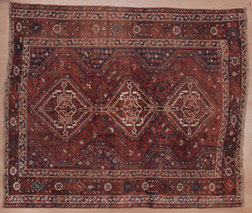
Iran Shiraz Gashghaï : 1,90 x 1,60 m
Iranian rug, Fars region (southwest Iran) wool, wool warp and weft, circa 1920. Wear throughout the rug. The stitches have been restored in our workshop.
This Shiraz Gashghaï, with its traditional graphics, is typical of 19th and early 20th century designs. On a brown background, three medallions are surrounded by a
multitude of motifs: zoomorphic roosters, göl (flowers), a few Medes stars (eight-pointed).
A main border composed of Medes stars and the 'S'* motif, is framed by two, lighter borders with hourglass and zoomorphic motifs. Despite its age, this rug remains
solid.
*S motif: originally symbolizing a double-headed dragon that could be seen on ancient Persian, Chinese and Celtic bronzes.


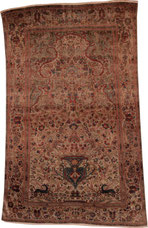
Iran Kashan : 2,08 x 1,28 m Sold
Iranian Kurk wool carpet*, cotton warp and weft, circa 1870. Used condition. Even wear throughout. Asymmetrical. Borders and tacks restored.
Early Kashan academic style, 'dozar' or rather 'ghaliché' format given the carpet's fineness, with a mihrab motif. The lower section features a vase flanked on either side by deer. Across the
field, a multitude of flowers and scrolls mingle with birds. The whole is enhanced by 'samovari' (flowers) and bird borders, framed by smaller 'aleh abassi' (tulips) and 'herati' (flowers)
borders. Note: abraches (a term describing variations in tone within the same color).
Due to its fineness and elegance, this rug could be described as 'Kashan Motashem'. The term 'Kashan Motashem' refers to the finest rugs from Kashan. The name Motashem also refers to an
illustrious master weaver (Ustad) from Kashan whose workshop produced rugs of exceptional quality, fineness, and design. Motashem was renowned for the elegance of his highly refined and richly
detailed rug cartoons.
Located in central Iran, Kashan began its rug-making tradition during the Safavid dynasty (1502-1736), specifically under the reign of Shah Abbas (1588-1629). Seeking to develop art in Persia,
Shah Abbas established schools where Ustads (master weaver-designers) worked. These Ustads created rug cartoons. The designs consisted of medallion motifs, hunting scenes, floral patterns, trees,
gardens, mihrabs, and were also inspired by mosaics. Major carpet creations were produced in the cities of Kashan, Kerman, Mashhad, Tabriz, and Isfahan. Carpet making became academic. Even under
the Safavids, Kashan carpets were renowned. After turbulent times, Kashan revived the art of carpet weaving in the 18th century. The creations of the late 19th and early 20th centuries are
considered major, both in Kurk wool and silk.
*Kurk wool: fine lamb's wool obtained by combing.


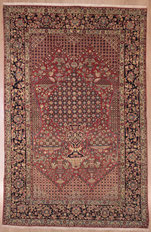
Iran Kashan : 2,10 x 1,35 m
Iranian wool kurk* rug, cotton warp and weft, circa 1870. Good condition considering its age. Regular wear and patina throughout. Edges and tacking have been restored. Solid, durable rug.
Ancient, academic Kashan with mihrab motif and dozar or rather 'ghaliche' format given the fineness of the rug. It features a traditional pattern of vases and bowls and a multitude of flowers evoking the 'thousand flowers' motif. This motif is most often associated with the Gashghaï Kashkuli (fars, south-west Iran). In fact, its origin probably comes from Indian Mughal carpets**.
Nadir-Shah (1688-1747), Persian Sefevid ruler, sacked Delhi in 1734 and brought Indian weavers, many craftsmen and a multitude of wealth back to Fars as slaves.
An elaborate wide border, with a floral motif on a navy blue background, is framed by two small 'herati' or 'samovari' (flower) borders. Its color is echoed in the central vase. Two cypress trees*** can be seen on either side of the flower vase.
*Kurk wool: fine lamb's wool combed from the wool. Strong, durable wool.
** Mughal: this word refers to the dynasty of Mongol origin that ruled India from the 16th to 18th centuries.
*** Cypress: Cypress refers to the Iranian prophet Zoroaster (6th century BC), who is said to have planted two cypress trees in the Khorasan desert to combat ogres. Legend has it that upon his
death, Zoroaster was reincarnated as a cypress, a tree, a palm or a drop of water (boteh).


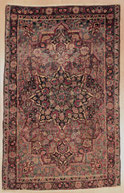
Iran Kerman Laver : 1,10 x 0,70 m
Iranian kurk wool rug, cotton warp and weft, circa 1870. Zarsharak format. Very
fine work. State of use on the entire surface but the carpet remains nevertheless very solid. Restoration of borders and breakpoints in our workshop. Some previous restorations of about fifty
years.
Located in the south-east of Iran, at an altitude of 1,800 m, the city of Kerman
has the reputation of being one of the most prestigious centers in the production of carpets. The village of Ravar is credited with having the finest pieces in the Kerman region. The name 'ravar'
has been transformed over time into 'lavar' and 'laver'
Stunning kerman laver consisting of a central navy
blue medallion in the shape of an eight-pointed star on a carmen red field and four pastel blue spandrels. A multitude of flowers are represented on the entire surface as well as in the
borders.


A little history ...
Marco Polo (1254-1324) who spent time in Kerman, wrote about the city. Here are some passages:
"Creman is a kingdom in Persia". "In this kingdom there are many stones called Turquoise". The ladies and ladies embroider very finely and nobly, with a needle, on silk sheets of all colors representing animals, birds, trees, flowers".
It should be noted that at this time it was shawls and not carpets.
The Meched Carpet Museum (Khorassan, northeastern Iran) has a fragment of a Kerman rug dating back to 1476. The production of Kerman’s workshop carpets gained momentum during the Safavid dynasty (1501-1732) and more precisely under the reign of Shahs Abbas (1588-1529), which corresponds to the golden age of the academic carpet in Persia.
Wishing to develop art in Persia, Shah Abbas created schools to train Ustads (master weavers). The latter made 'boxes' of carpets. The drawings consisted of medallions, scenes of hunts, flower-picking, trees, gardens, mihrabs but also mosaics.
The major carpet creations were made in the cities of Kashan, Kerman, Tabriz, Meched and Isfahan. The carpet became academic.
A brutal halt to the achievements of Kerman carpets occurred at the fall of the Sefardita dynasty, mainly due to Afghan invasions. In 1794, under the Qadjar dynasty, the city of Kerman was destroyed. It was from the 19th century that workshops were recreated by local craftsmen but also by European companies for the European market and from 1920 for the American market.
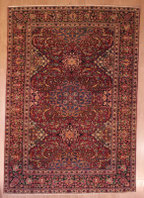
Iran Ispahan : 2,12 x 1,35 m Sold
Iranian kurk wool rug (fine lamb's wool collected by combing), cotton warp and
weft, circa 1900. Rug restored in our workshop (stop stitches and borders). Very good condition considering its age. Rare. Strong and durable rug.
Isfahan rugs are among the most beautiful and finest rugs in Iran. The first
productions began during the Safavid dynasty (1501-1732) and more precisely under the reign of Shah Abbas the Great (1588-1629). Interrupted in the 18th century by an Afghan invasion, production
did not reappear until the end of the 19th century.
But it was especially at the beginning of the 20th century that the achievements
took off thanks to the initiative of traders from Kashan and Tabriz. By tradition, these achievements were family, at the inhabitant's homes.
Splendid Isfahan in dozar format, having required great mastery in its realization.
The Ustad (Master Weaver) designed a remarkable cartoon of this classic and timeless carpet. On a burgundy red background, a series of medallions and semi-medallions are aligned, surrounded by a
multitude of flowers, scrolls and botehs*. A beautiful main border on a navy blue background, rich in floral motifs, is framed by small aleh abassi** and samovari*** borders. The whole gives a
perfect balance. Beautiful polychromy.
*Boteh: Ancient motif with different meanings. It can represent the transformation
of Zoroaster into a cypress, symbol of eternity, but also into a drop of water, a palm, a tree. The term boteh means "flowering bush" in Persian. There is a similarity with yin and
yang.
**Aleh abassi: motif of stylized tulips referring to Shah Abbas.
***Samovari: this motif is composed of small flowers represented on the borders
that surround the carpet. It is found on the majority of Iranian rugs.
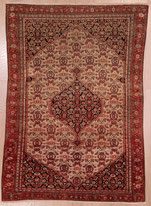
Malayer Iran : 1,38 x 0,97 m
Iranian Kurk wool carpet*, cotton warp and weft, circa 1870. Very good condition considering its age. Even wear throughout. Borders and tacks restored.
The town of Malayer is located 80 km from Hamadan, on the road to Arak (Western Iran). Production includes a variety of highly stylized floral and geometric
designs.
This rare antique Malayer carpet, in the zaronim format, was made in one of the 240 villages in this region. This carpet is of strong Kurdish tradition and comes
from villages north and west of Malayer. The field of the carpet features a refined interpretation of the traditional 'mahi' motif (a diamond-shaped motif also called 'fish mouth') framed by
stylized 'botehs'**. A main border composed of 'samovari' and 'botehs' motifs frames the field of the carpet. Beautiful harmony of colors, abraches in the beige field. This Malayer rug, despite
its age of 150 years, has retained its original colors, which proves the quality of the dyes.
*Kurk wool: fine lamb's wool obtained by combing.


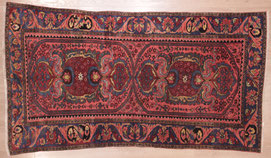
Iran Malayer : 2,10 x 1,10 m
Iranian wool, cotton warp and weft carpet, circa 1930. Good condition. The borders and stopping points have been restored.
Note: Three stains remained after washing (see photos).
Atypical drawing for this Malayer in dozar format and in shades of pink. Two original medallions incérant of floral motifs, take up the entire field of the carpet. A wide border with a floral pattern and on a mottled blue background is framed by two small borders with the 'hérati' (flowers) pattern.


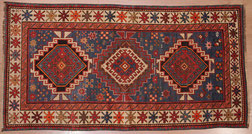
Caucasus Kazak : 1,78 x 0,93 m
Caucasian wool rug, wool warp and weft, circa 1900. Very good condition. Normal wear throughout, considering its age. Borders and end stitches restored. Rare.
The term Kazak refers to rugs knotted in a mountainous region encompassing Georgia and Armenia. The Kazaks include the small towns and villages of Bordj Bou Arreridj, Farchalo, Lambalo, Karachop,
etc.
This authentic Caucasian Kazak rug consists of three medallions with zoomorphic motifs, linked by hourglasses, symbolizing the passage of time. On the carpet's surface, motifs specific to the
Kazakhs are depicted: the 'S' motif*, Medes stars (eight-pointed stars), and göl (flowers). This carpet, despite its age, has retained its original colors, which proves the quality of the
dyes.
Some abraches: a term describing a variation of tones within the same color.
*The 'S' motif originally represented a two-headed dragon, which could be seen on ancient Persian, Chinese, and Celtic bronzes.


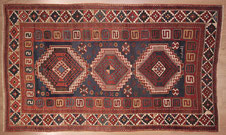
Caucasus Kazak : 2,20 x 1,30 m
Caucasian wool carpet, wool warp and weft, dated 1320 or 1902 (Christian calendar).
Very good condition. Rare.
The name Kazak refers to carpets knotted in a mountainous area including Georgia
and Armenia. Kazaks include the small towns or villages of Bordjalou, Farchalo, Lambalo, Karachoph ...
Authentic Kazak consisting of three medallions inserting, for the middle one, an
hourglass motif symbolizing the passing of time, for the other two, zoomorphic spiders (tarantulas). A first border as well as two smaller ones take up the 'S' motif originally representing a
two-headed dragon that could also be observed on ancient Persian, Chinese and Celtic bronzes. A last border on a beige background is inspired by an old brickwork. Despite its age, the colors of
this Kazak have not faded. Some abraches (term designating a variation of tones in the same color) are characteristic of this origin.
Note: Recent 'Kazak' rugs, made by the Pashtuns since the 90s, most often in large
dimensions, take up the patterns of old Caucasian rugs but are in no case Caucasian rugs.


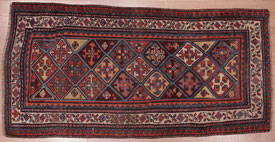
Caucasus kazak : 1,93 x 0,97 m
Caucasian wool rug, circa 1930. Used condition. Stop points restored in our
workshop.
The Kazak name refers to rugs knotted in a mountainous area including Georgia and
Armenia.
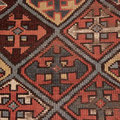
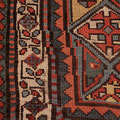
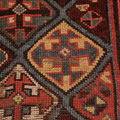
This rug is composed of a repetitive geometric pattern in the center, and is
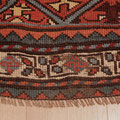
delimited by borders that highlight the field of the rug. We find an ale abassi border (tulip border) and a 'running water' border that surround a beige herati border, composed of flowers and
swastikas. The quality of the colors that have not faded over time. Note a drop in the border pattern.
Caucasus Kazak : 2,40 x &,30 m
Caucasian wool rug, wool warp and weft, dated 1949. Very good condition. Rare.
The name Kazak designates carpets knotted in a mountainous area including Georgia
and Armenia.
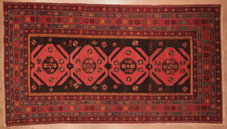
This authentic Kazak, in 'kellé' format, is the perfect example of a traditional
village work specific to Caucasian rugs and of a bygone era. It is possible, given its graphics, that it is a kazak 'Lori Pambak', a term designating rugs made in the North of Armenia in small
villages attached to Lori whose capital is Pandak and located along the Georgian border.
On a very dark navy blue field (black), four very refined geometric patterns in
'crushed strawberry' color contrast with different worked borders. On the 'black' field, we notice patterns of hourglasses, göls (flowers), as well as the date 1949 reproduced four times. The
carpet has been signed, in a medallion, with the initials C and A. The octagons inside each medallion represent the Universe.
Borders:
- 'Aleh abassi' border (tulip border) orange yellow.
- 'S' pattern border. This motif originally represented a two-headed dragon that
could be seen on ancient Persian, Chinese and Celtic bronzes.
Note, a small restoration (2 cm²) on the back of the carpet, not visible on the
place.


Iran Ferahan : 1,84 x 1,36 m Sold
Farahan or Ferahan or Feraghan.
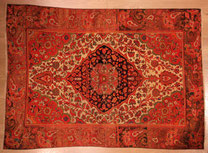
Iranian Kurk* wool rug, cotton warp and weft, circa 1880. Normal condition of use
on the entire rug, given its age (140 years). Borders and stopping points restored in our workshop. Other restorations have been carried out over time. Rare.
Located north of Arak (former name: Sultanabad), western Iran, the Farahan district
included villages renowned for their quality of weaving. Very popular with the English from the 19th century onwards, Farahan rugs are resistant which in no way detracts from their elegant side.
They are renowned for their sobriety. These are rugs that have a short pile with excellent quality wool, dyed from vegetable colors. Many Farahans have a central medallion pattern that is always
well balanced, enhanced by a samovari** border. These rugs were often intended for the European market and more particularly for England. This elegant dozar format farahan is a perfect example of
ancient achievements. The orange color dominates the entire carpet. A superb black medallion, with orange and green floral patterns, contrasts with the ivory field of the carpet. The main border
features floral motifs and botehs*** and its abrached colors**** give a lot of charm to this splendid Farahan.
*Kurk wool: fine lamb wool collected by combing. Strong and durable
wool.
**Samovari: this pattern consists of small flowers represented on the borders
surrounding the rug. It is found on the majority of Iranian carpets. ***Boteh: Ancient pattern with different meanings. It can represent the transformation of Zoroaster into a cypress, symbol of
eternity, but also into a drop of water, into a palm, into a tree. The term boteh means "flowering bush" in Persian. There is a similarity with yin and yang.
****Abrache: term designating a variation of tones in the same color.
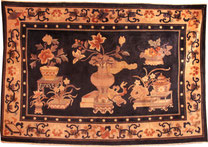
Baotou China : 1,76 x 1,20 m
Chinese wool rug, cotton warp and weft, circa 1940. Good condition. Rug restored (borders and stop stitches) and recolored.
City of Inner Mongolia, located on the left bank of the Yellow River (Huang He: 5164 km). The art of weaving Baotou (Paotou) rugs began in the early 19th century. The majority of Baotou rugs from
the late 19th and early 20th centuries are generally on a blue background, more rarely on a red background, which distinguishes them from other Chinese rugs. We most often find themes of
landscapes, clouds, floral motifs, animals, imaginary animals such as the phoenix or the Fo dog, but also human representations and interior scenes.
Authentic Baotou rug called 'scholar's rug'. On a plain navy blue field, a traditional interior scene depicts scholarly objects. On the left, several flowered vases, one of which is a peony (symbols of well-being and happiness), rest on a stool. According to the ancient Chinese, the composition of a vase bearing a flowering branch means: 'Please find peace and rest according to your desires'. In the center, a lotus (symbols of purity, fertility, and perfection) in a large vase rests on a base surrounded by books and a scroll (parchment). On the right, various objects complete this scene: a bowl of grapes, a vase of flowers, a jar on a small piece of furniture. A flowered frieze on a light background frames this scene where in each corner we can see a scholarly object: a chessboard, books, a scroll (parchment) ...


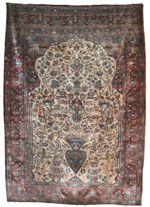
Kashan Iran : 1,85 x 1,30 m Sold
Iranian carpet entirely in silk, around 1880. Exceptional.
Carpet consisting of a mihrab and a vase decoration with flowers. On each side of the vase is a bird on a base. Two columns support the mihrab. The field of the carpet is highlighted by samovari borders (flowers). Signs of wear on the entire carpet. It should preferably be placed on the wall. In addition to the opinion of the curator of the Tehran museum (see below, bottom of page), we have an expertise which considers that this kashan is a Motashem kashan.
Motashem (Motachem or Moshtashan): The name of Motashem refers to an illustrious Master weaver (Ustad) from Kashan whose workshop produced rugs of exceptional quality, finesse and designs. Motashem was renowned for the elegance of these highly refined and rich carpet cartons. The term kashan Motachem designates the finest rugs in Kashan. Ghalitché format: Ghalitché is a term used for very fine carpets.
The name dozar is the most common for carpets with dimensions of 2.00 x 1.30 m. The zar is a Persian unit of measure corresponding to 1.06 m. The dozar corresponds to 2 times the zar.
The making of Kashan carpets began during the Sephardic dynasty (1502-1736) precisely during the reign of Shah Abbas (1588-1629). Wanting to develop art in Persia, Shah Abbas created schools to train Ustads (master draftsmen weavers). The latter made 'cartons' of carpets. The designs consisted of medallion patterns, scenes of hunts, flower branches, trees, gardens, mihrabs (like this one) but also mosaics. The major carpet creations were made in the cities of Kashan (central Iran), Tabriz and Isfahan. The carpet became academic. After troubled times in the 18th century, Kashan revived the art of carpeting. The achievements of the end of the XIX century and the beginning of the XX are considered major both in silk and in kurk wool.
We contacted the Tehran Carpet Museum in April 2016 to get an opinion. The museum curator was kind enough to answer us:
'Hello, Based on the photo received, it seems to us that the carpet is a kashan from the middle of the Qadjar period. It is a precious museum carpet, despite the irregularities and past colors due to use and the passage of time. But, it should be added that one can never give a definitive opinion on a carpet, based only on these photos, without seeing it and examining it closely. Cordially.'
Tehran Carpet Museum 04/19/2016 (French translation)


