
Oriental Carpet Villagers :
Loori, hosseinabad, malayer, bidjar, senneh.
A reflection of local craftsmanship, it was from the second half of the 19th century that many rug designs and patterns were developed, often drawing inspiration from earlier creations.
These creations bear witness to ancestral know-how passed down from generation to generation.
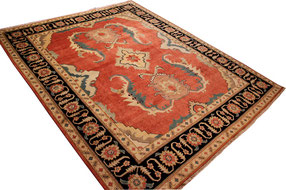
Iran Hériz : 3,00 x 2,45 m
Iranian wool rug, cotton warp and weft, circa 1950-60. Very good condition. Interesting and unusual format.
Inspired by the Heriz Serapi, this rug is distinguished by a refined and balanced decor. Two patterns on either side of a more discreet central medallion stand out from a plain coral background
(kafzadé). The main border, on a dark blue background, takes up the central pattern. This
rug with its atypical decor is inspired by a family tradition. Beautiful achievement.
Located in Iranian Azerbaijan, east of Tabriz, Heriz is a city bringing together the production of neighboring villages such as Ahar, Goravan, Serapi, Bakhshayesh ... The Heriz have the
reputation of being solid and very wear-resistant rugs due to excellent quality wool and knotted with the turkbaff knot. At the end of the 19th century, merchants from Tabriz had carpets woven in
Heriz, bringing a more "refined" side. Despite this change, many weavers did not want to use cardboard and referred to traditional designs. At that time and until the beginning of the First World
War, silk carpets were also made. They are now very rare and highly sought after.
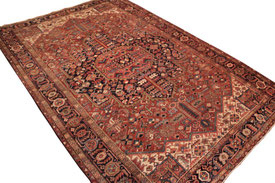
Iran Heriz : 3,30 x 2,25 m
Iranian wool rug, cotton warp and weft, circa 1920. Normal wear and tear for its age, but the rug remains sturdy. The borders and end stitches have been restored.
Located in Iranian Azerbaijan, east of Tabriz, Heriz is a town that brings together the production of neighboring villages such as Ahar, Goravan, Serapi, and Bakhshayesh. Heriz rugs are renowned
for their strength and durability, thanks to the excellent quality of the wool and the Turkbaff knot. Heriz rugs with geometric designs and central medallions are inspired by a family tradition.
At the end of the 19th century, merchants from Tabriz commissioned large-scale rugs to be woven in Heriz, giving them a more refined look. Despite this shift, many weavers refused to use cartoons
and instead relied on traditional designs or "vaghirehs" (designs). During this period and until the beginning of the First World War, silk carpets were also produced. They are now very rare and
highly sought after.
This authentic traditional heriz features a central medallion whose octagonal 'heart' represents the Universe. Various motifs are found within, such as boteh*, eight-pointed Median stars, and göl
(flowers). The main border repeats a göl and boteh motif, framed by two smaller borders with the 'S'** motif. A beautiful balance of coppery and patinated colors.
*Boteh: An ancient motif with various meanings. It can represent the transformation of Zoroaster into a cypress tree, a symbol of eternity, but also into a drop of water, a palm frond, or a tree.
The term boteh means "flowering bush" in Persian. There is a similarity to yin and yang.
** The 'S' motif originally represents a two-headed dragon, which could be seen on ancient Persian, Chinese, and Celtic bronze

Iran Tafresh : 2,00 x 1,35 m
Iranian rug from the Arak region (western Iran) Kurk * wool, cotton warp and weft,
1940-50. Very good state. The borders have been restored in the tradition.
Beautiful achievement. Near Saveh, the town of Tafresh is located northwest of
Farahan. This traditional dozar-size tafresh consists of a large rounded blue medallion highlighted on a solid red background (kafzadé). Spandrels in blue and brown colors recall the central
medallion. The main border consists of flowers and is surrounded by small "herati" or "samovari" borders **. On either side of the medallion, we notice a line of "boteh" ***.
* Kurk wool: fine wool taken from the necks of lambs.
** Border herati (or samovari): this pattern consists of small flowers depicted on
the borders that surround the carpet. It is found on the majority of Iranian carpets
*** Boteh: Ancient pattern with different meanings. It can represent the
transformation of Zoroaster into cypresses, a symbol of eternity, but also into a drop of water, a palm, a tree. The term boteh means "flowering bush" in Persian. There is a similarity to yin and
yang.
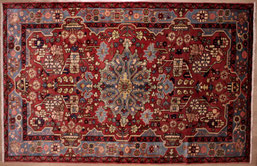
Iran Nahavand : 2,45 x 1,47 m
Iranian rug, wool, cotton warp and weft, circa 1980-90. Very good condition, beautifully crafted.
Village rug from the Hamadan region (western Iran), encompassing 1200
villages.
The motif of this beautiful Nahavand is typical of this region: a medallion with
rounded rosettes and, within its field, bouquets of flowers (göl). This traditional Nahavand boasts beautiful wool quality and vibrant colors. The quality of Nahavand rugs is comparable to that
of Malayer and Nanadj rugs. A sturdy and durable rug.
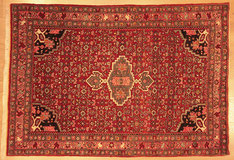
Iran Bidjar : 1,60 x 1,12 m
Carpet from Iranian Kurdistan (western Iran) kurk wool (fine lamb's wool), cotton
warp and weft, circa 1940. Very good condition.
Traditional Bidjar in zaronim format. A central medallion as well as four spandrels
stand out from a patinated red background composed of the 'mahi' (diamond) motif. Three borders composed of a stylized floral pattern frame the rug. Strong and durable mat.
Located in Kurdistan, bidjars are held in high esteem, due to their great
robustness and resistance to wear. These are rugs appreciated by enthusiasts because of their authenticity and their typically Persian charm. Carpets from Bidjar and surrounding villages are made
with the turkbaff knot (double knot) and are renowned for their great resistance to wear. A traditional bidjar has 3 to 5 rows of weft threads. In addition, the quality of the wool and the
weaving make these rugs virtually indestructible. They are called 'iron carpets'.

Iran Senneh : 3,67 x 0,90 m
Iranian wool rug, cotton warp and weft, circa 1980. Very good condition. Strong and
durable rug.
Can withstand heavy traffic. Some variations in the red tones.
Beautiful kenareh-format senneh consisting of the "mahi" and "göl" patterns. In the
center, on a red 'kafzadé' background (plain field), nine medallions stand out with a beautiful interpretation of the 'gôl farang'* (French rose) pattern. The main border uses the 'göl farang'
pattern.
* Göl farang: The influence comes from the Damascus rose whose rose pattern
inspired Safavid carpets, which in turn influenced European tapestries. At the end of the 19th century and the beginning of the 20th century, the göl farangi pattern, which means rose or flower
of France, is found in the Orient on Karabakh carpets and kilims (Caucasus), on certain Iranian carpets such as those of Bidjar, Senneh and the Bakthiar of the village of Faradoumbeh, as well as
on Moldavian kilims from the Balkans.
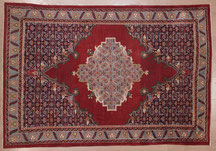
Iran Senneh : 1,75 x 1,21 m
Iranian wool carpet, cotton warp and weft, circa 1970. Very good condition.
Solid, durable rug. Can withstand heavy traffic. Stitches have been restored in our workshop.
On a red kafzade (plain) background, a large central medallion stands out, framed by four spandrels decorated with the traditional 'mahi' (fish mouth) motif. Various borders, including a wider
one with a 'herati' (flowers) motif, surround the carpet field. Note the large abrache (variation in tone within the same color) on the red background.
Ancient name for the town of Sanandaj, Senneh is located in Iranian Kurdistan and is renowned for its knotted-stitch rugs. Senneh kilims are also highly appreciated by lovers of authentic
carpets. The workmanship is highly refined, both in the technique used and in the designs, which have been passed down through the generations.
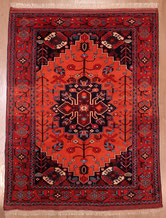
Iran Kurdi : 1,80 x 1,35 m Sold
Iranian wool kurk rug, wool warp and weft, circa 1970-80. Very good
condition.
Kurdi or kordi rug made by Iranian Kurds. Unlike rugs made in Iranian Kurdistan
(Northwest Iran), this rug was made by the Kurds of Khorasan (Northeast Iran). The texture is very different from Senneh or Bidjar rugs.
Kurdis are excellent quality rugs. They are fine and elegant.
This kurdi in kurk wool* sees its inspiration in the antique rugs of Heriz. A large
central navy blue medallion, surrounded by trees of life, peacock zoomorphs and göls (flowers), is highlighted on an abrached orange background**. Each spandrel is composed of an octagon, a tree
of life, göls and zoomorphs. A wide border with floral motifs is framed by two small 'running water' borders. Beautifully finished on each side with a kilim and braided fringes.
Note: the rug is slightly trapezoidal.
*Kurk wool: fine lamb's wool collected by combing.
Strong and durable wool.
**Abrache: term designating a variation of tones within the same color.

Caucasus kazak : 2,40 x 1,30 m
Caucasian wool rug, wool warp and weft, dated 1949. Very good condition.
Rare.
The name Kazak designates carpets knotted in a mountainous area including Georgia
and Armenia.
This authentic Kazak, in 'kellé' format, is the
perfect example of a traditional village work specific to Caucasian rugs and of a bygone era. It is possible, given its graphics, that it is a kazak 'Lori Pambak', a term designating rugs made in
the North of Armenia in small villages attached to Lori whose capital is Pandak and located along the Georgian border.
On a very dark navy blue field (black), four very
refined geometric patterns in 'crushed strawberry' color contrast with different worked borders. On the 'black' field, we notice patterns of hourglasses, göls (flowers), as well as the date 1949
reproduced four times. The carpet has been signed, in a medallion, with the initials C and A. The octagons inside each medallion represent the
Universe.
Borders:
- 'Aleh abassi' border (tulip border) orange yellow.
- 'S' pattern border. This motif originally represented a two-headed dragon that
could be seen on ancient Persian, Chinese and Celtic bronzes.
Note, a small restoration (2 cm²) on the back of the carpet, not visible on the
place.

Caucasus Kazak : 1,93 x 0,97 m
Caucasian wool rug, circa 1930. Used condition. Stop points restored in our
workshop.
The Kazak name refers to rugs knotted in a mountainous area including Georgia and
Armenia.
This rug is composed of a repetitive geometric pattern in the center, and is
delimited by borders that highlight the field of the rug. We find an ale abassi border (tulip border) and a 'running water' border that surround a beige herati border, composed of flowers and
swastikas. The quality of the colors that have not faded over time. Note a drop in the border pattern.
Iran Loori :
Located to the west and further south in Fars, the Lur people consist of a semi-nomadic population. The most common sizes of rugs range from dozar (about 2 m²) to kellé (1.50 x 3.50m approximately). Geometric designs can be reminiscent of Caucasian rugs. They are warm and comfortable rugs that fit into both contemporary and traditional interiors, with stylish and timeless graphics. The charm of these rugs is above all due to their simple or even naïve patterns, the quality of the wools and their astonishing colors.

Iran loori : 3,26 x 1,80 m
Iranian wool rug, cotton warp and weft, circa 1950. Good
condition.
Authentic loori with geometric graphics on an eggplant background. Warm and brash
colors * due to the quality of the wools and dyes. Rare by its dimensions of kellé format. This loori is the perfect example of a bygone era. Strong and durable mat.
* Abrache: term designating a variation of tones in the same color.
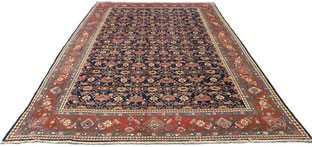
Iran Sarough : 3,25 x 2,15 m
Iranian rug from the Arak region (western Iran), wool, 1950-60. Very good
state.
Carpet in 'mian farsh' format in shades of blue consisting of the diamond pattern
"mahi". A more colorful border, predominantly red, enhances the field of the carpet. Beautiful quality of wool. Strong and durable.
The region of Arak included various centers of carpet production which reproduced
the characteristics of the carpets made in the city of Sarough.
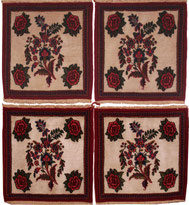
Set of four iranian rugs : 0,45/0,46 x 0,47 x 0,48 m
Iranian rugs in wool and viscose (artificial silk), cotton warp and weft, circa 1980. Very good condition.
Small rugs with floral motifs on a beige (viscose) background, suitable for floor, wall, or armchair use.
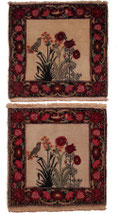
Set of two Sarouk Iran rugs : 0,50 x 0,50 m Sold
Pair of Iranian rugs, Arak region (western Iran), wool, cotton warp and weft, circa 1980. Very good condition.
Small rugs with floral and bird patterns. Beautiful borders with flower patterns.
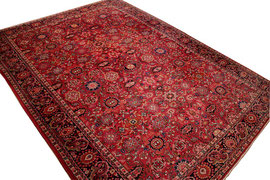
Malayer Nanadj Iran : 3,47 x 2,62 m
Iranian wool rug, cotton warp and weft, circa 1980. Very good condition. Comfortable, solid and durable rug.
Very beautiful Malayer Nanadj rug made in the Hamadan region, western Iran. The production includes a variety
of floral or geometric decorations. We find on this entire rug the samovar motif called "turtle" motif. Beautiful balance of colors in red-copper tones. Tending to become rare.
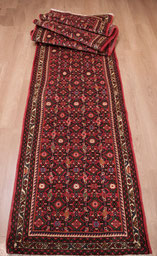
Malayer Hosseinabad Iran : 5,94 x 0,80 m
Iranian rug from the Arak region (western Iran) wool, cotton warp and weft, circa 1980-90. Perfect condition. Can withstand heavy traffic.
The small town of Hosseinabad is located southwest of Malayer. The name
"Hosseinabad" includes a district of about fifteen villages.
Malayer Hosseinabad in kenareh format, composed of the 'mahi' or fish
mouth motif reminiscent of ancient Malayer. An ecru border with a flower motif called 'hérati' is framed by two small borders with a garland motif. It is becoming difficult to find kenarehs of this quality and in dimensions exceeding three meters
long.

Iran kolyai : 2,28 x 1,22 m
Rug from Iranian Kurdistan (northwestern Iran) wool, cotton warp and weft, circa
1980. Good condition, some signs of wear on the edges.
Elegant koliaï rug with warm colors and original graphics inspired by previous
creations. Like all Kurdish rugs, the wool is of excellent quality, which makes these rugs solid and durable. Ideal for a living room or a place of intensive passage. A central red medallion
stands out against a background with a herati or samovari (diamond) motif. Four spandrels balance the carpet field. A beautiful red border highlights everything.
Note: a darker abrache in the field of the carpet.

Iran bakthiar faradoumbe : 3,00 x 1,70 m Sold
Iranian wool rug, cotton warp and weft, 1940. Very good condition. Beautiful
achievement. Exceptional.
Borders and breakpoints have been restored in our workshop. Solid
carpet.
This magnificent faradoumbé is made up of the "göl farang" (French rose) motif
reminiscent of the floral designs of Aubusson tapestries. A lot of attention and mastery when making this kellé format rug.
The influence comes from the Damask rose whose rose pattern inspired Safavid rugs,
which in turn influenced European tapestries. At the end of the 19th century and the beginning of the 20th century, this motif is found in the East on carpets and kilims from Karabakh (Caucasus),
on certain Iranian carpets such as bidjars and sennehs, as well as on Moldavian kilims from the Balkans. Located in the west of Iran in the region of Chahar Mahal where live populations of
“bakthiari” origin of Lur stock, the bakthiars take up traditional “garden” or “4 seasons” motifs which date from the Safavid period. , but also medallion rugs. The major achievements of the
Bakhtiaris include the villages of Shahre Kord, Shalamzar, Tchalechotor, Sarman, Armenibaft as well as Faradoumbé with the göl farang motif. Reflecting local craftsmanship, it was from the second
half of the 19th century that many carpet designs and patterns were developed, most often inspired by previous achievements. These creations testify to an ancestral know-how transmitted from
generation to generation.
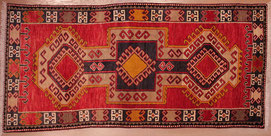
Kozac Anantolia : 2,03 x 0,94 m
Anatolian carpet, wool, wool warp and weft, circa 1950-60. Very good
state.
Located in western Anatolia, the small town of Kozak is about twenty kilometers
from the city of Bergamo. The name "kozak" derives from the word kazak, a mountainous area including Georgia and Armenia (Caucasus). The decoration of this kozak, composed of three medallions, is
reminiscent of Caucasian Kazak carpets. Many Turkish rugs since the 19th century have been made by Armenians. Kozaks are of Caucasian origin. This rug, on a red background, is made up of a
beautiful harmony of abrached colors*. The field of the carpet features zoomorphic ram horns, as well as the 'S' motif symbolizing a two-headed dragon. Warm rug, beautiful
creation.
*Abrache: term designating a variation of tones in the same color.
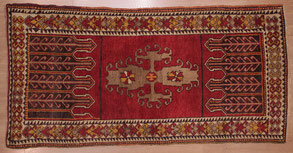
Kozak Türkiye : 2,00 x 1,02 m
Anatolian rug, wool, wool warp and weft, circa 1950. Good condition. The stopping points have been restored in our workshop. Solid and durable rug.
Located in western Anatolia, the small town of Kozak is about twenty kilometers
from the city of Bergamo (Western Turkey, Aegean region). The name "kozak" derives from the word kazak, a mountainous area including Georgia and Armenia (Caucasus). Many Turkish rugs since the
19th century have been made by Armenians under the supervision of Armenian Ustads (Master weavers).
On a plain red 'kafzadé' background, a medallion with zoomorphic shapes stands out,
and on both sides, certainly, 'trees of life' motifs. All around, a border features zoomorphic motifs (ram's horns, wolf's mouth).
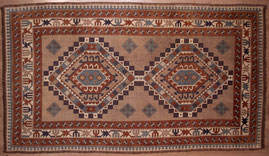
Kars Türkiye : 2,75 x 1,60 m
Rug from present-day northwest Turkey, wool, wool warp and weft, circa 1950. Good overall condition. Small old restorations in the border. Regular wear and beautiful patina on the entire rug. The stopping points have been restored in our workshop.
The city of Kars is located in ancient Eastern Armenia where a large Armenian
community made rugs and kilims. In the 9th and 10th centuries, it was an important city in the Kingdom of Armenia. The region of Yerevan and Kars is credited with the 'dragon rugs'. The patterns
are similar to those of Caucasian rugs from Armenia and Georgia. The weaving tradition is ancient. The rugs are most often woven and knotted by Armenians, in small workshops or at home. Kars rugs
are called 'Turkish Kazak' or 'Kazak Kars'.
This rug features two traditional medallions surrounded by several borders. A
border on a beige background (comb pattern?) is framed by two smaller borders with Medes star patterns. The outer border uses the "aleh abassi" or "tulip border" pattern.

Yuruk Türkiye : 2,65 x 1,15 m Solde
Cappadocia rug, Central Anatolia, wool, wool warp and weft, circa 1960. Wear and tear. Beautiful patina. The stopping points have been restored in our workshop. Solid and durable rug.
The name 'Yuruk', which can be translated as 'those who walk' (nomads), corresponds
to groups of Kurdish origin who lived and moved around Central Anatolia. Colorful and warm rug. On a solid red background stands out a large medallion. Orange-colored borders contrast with the
spandrels and the center of the rug.

Turkiye : 1,97 x 1,04 m
Türkiye wool rug, wool warp and weft, circa 1970. Good condition. Breakpoints
restored in our workshop.
Carpet inspired by the Caucasian 'Lesghi' of Dagestan. Three stars each composed of
eight branches and four arrows, completed in the center of an octagon representing the universe. The main border consists of eight-pointed Medes stars on a beige background. Beautiful patinated
colors.